Digital education courses for teachers
Bring technology into your classroom with purpose. Erasmus+ courses in Bordeaux on artificial intelligence and practical digital tools for teachers.
Plan your Erasmus+ mobilityDigital education is no longer a specialism reserved for a few enthusiasts; it has become part of every teacher’s craft. From interactive whiteboards and collaborative documents to the rapid arrival of artificial intelligence, the tools available to teachers have multiplied, and so have the questions. Which tools genuinely help students learn? How do you save time rather than lose it? How do you keep data safe and use technology ethically? Our digital education category answers exactly these questions.
Designed for teachers and education staff taking part in an Erasmus+ mobility, these courses in Bordeaux focus on practical, classroom-ready use of technology. You will not spend the week wrestling with abstract theory or complicated set-up. Instead, you will leave with tools, activities and habits you can use the moment you return to your school.
Why digital education matters for teachers
Students today live in a digital world, and their teachers are expected to guide them through it, safely and critically. Yet most teachers have had little dedicated training in how to choose and use digital tools well. The result is often frustration: too many apps, not enough time, and a nagging sense that technology should be helping more than it does.
Effective digital education is not about using the newest gadget. It is about starting from a clear learning goal and choosing the tool that serves it. Done well, technology can make abstract ideas visible, give every student a voice, provide instant feedback, and free teachers from repetitive tasks. Done poorly, it simply adds noise. Our courses are built around this distinction, and they align with recognised European standards such as the European Commission’s DigCompEdu framework, which describes the digital competences educators need.
Key benefits teachers report after our digital education courses include:
- Time saved on planning, resource creation and assessment.
- Higher engagement through interactive and collaborative activities.
- Confidence to choose tools wisely rather than following trends.
- Ethical, safe practice, including data protection and responsible use of AI.
- A transferable toolkit that colleagues can adopt too.
Who are these courses for?
Our digital education courses for teachers welcome educators at every level of confidence with technology: primary and secondary teachers, vocational trainers, ICT coordinators, school leaders planning a whole-school digital strategy, and Erasmus+ coordinators preparing a staff mobility. No advanced technical background is required, only curiosity and a wish to make lessons more engaging.
The AI for teachers course is designed for teachers who want to understand how artificial intelligence can support lesson planning, differentiation, feedback and assessment without replacing their professional judgement. The digital tools course suits teachers who prefer to start from concrete classroom applications and build a practical toolkit step by step.
Digital education courses for teachers in this category
The digital education category currently includes two complementary courses. Many teachers take both, but each stands on its own.
AI for teachers
Understand what artificial intelligence can and cannot do in education, and use it to plan lessons, create materials, give feedback and support assessment, responsibly and ethically.
Digital tools for teachers
Build a practical toolkit of the tools that matter: interactive activities, collaboration and creativity apps, and digital resources for feedback and assessment.
Both courses share the same philosophy: purposeful, sustainable use of technology that fits the realities of a busy classroom. They also connect naturally with our other categories, for example using digital tools to support inclusive education or to power the project work explored in innovative pedagogy.
What you will gain
By the end of a digital education course you will be able to:
- Match a digital tool to a clear learning objective, rather than the other way round.
- Design engaging, interactive activities that increase participation.
- Use technology to give faster, richer feedback and to streamline assessment.
- Apply AI thoughtfully to save time on planning and content creation.
- Teach digital citizenship, safety and responsible use to your students.
- Share what you have learned with your colleagues and school.
Just as importantly, you will gain a network of European colleagues facing the same challenges, and often the beginning of future eTwinning projects and mobilities.
How our courses work
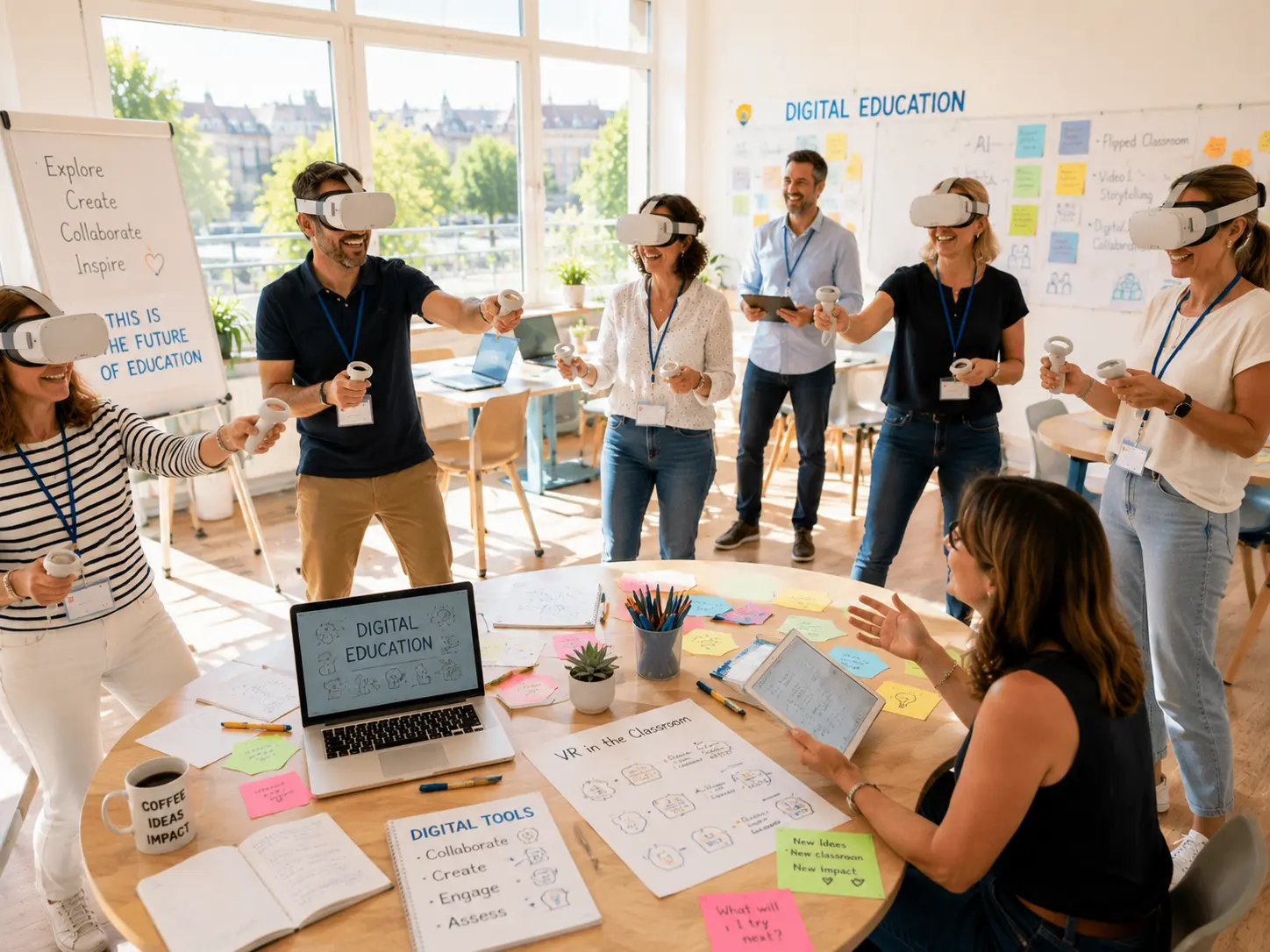
Every course in this category follows the same clear, practical rhythm. Each morning introduces a principle or a tool; each afternoon puts it straight to work on real lesson ideas that you design and test with fellow teachers. You experience the methods as a learner before adapting them as a teacher, and you leave with concrete materials rather than notes.
Courses run over one week in small groups, in English, with trainers who are practising educators. A cultural and social programme runs alongside the training, and you receive a Europass Mobility certificate and a certificate of attendance for recognition by your National Agency.
Digital practices you will take back
These courses are deliberately concrete. Among the ready-to-use practices you will practise and take home are:
- AI-assisted lesson planning workflows that save preparation time while keeping you in control.
- Formative assessment tools such as instant quizzes and polls that make learning visible.
- Differentiation with adaptive apps so every student works at the right level of challenge.
- Interactive content creation for videos, presentations and collaborative boards.
- Data protection routines for responsible, GDPR-aware use of AI and digital platforms at school.
- A tool-selection grid to evaluate any new app against your own teaching goals.
Each practice is tested on real lesson examples during the week, so you leave with a personal toolkit you can use immediately and share with colleagues.
Erasmus+ funding
Teachers, trainers, headteachers, school leaders and any staff of an education organisation can receive an Erasmus+ KA1 grant so your institution may cover travel, accommodation, meals, cultural activities and the fees of these digital education courses for teachers through the grant. Our courses are priced to fit within it. For a full overview of how funding works, see our Erasmus teacher training courses page, or go straight to plan your mobility.
Why Bordeaux
Bordeaux combines a UNESCO-listed city centre, a lively student atmosphere and excellent connections across Europe, making it an inspiring and practical base for teacher mobility. Between sessions you can explore the city’s architecture, culture and surroundings, from the Cité du Vin to the nearby Atlantic coast. It is a place where professional development and cultural discovery go hand in hand.
Frequently asked questions
It brings together our Erasmus+ courses that help teachers use technology purposefully: choosing the right tools, creating engaging activities, and using artificial intelligence to save time and support learning. The focus is always classroom impact, not technology for its own sake.
Two courses: AI for teachers, on using artificial intelligence in everyday teaching, and Digital tools for teachers, on interactive activities, collaboration and assessment tools.
No. Both courses are designed for everyday teachers, whatever their starting point. You will work with practical, classroom-ready tools rather than coding or technical set-up.
Yes. Every course in this category is eligible for Erasmus+ KA1 funding, which can cover travel, accommodation, meals and course fees for teachers and school staff.
In Bordeaux, France, in small groups of up to sixteen participants, with sessions running throughout the year.
Bring digital learning to your classroom
Choose an AI or digital tools course, or take both, and turn technology into a genuine asset for your students.
Plan your Erasmus+ mobility