
Social emotional learning course: anti-bullying and classroom climate
Think it through together, leave with concrete activities: an Erasmus+ week in Bordeaux on psychosocial competencies, empathy and emotional regulation to prevent bullying and transform your classroom climate.
Plan your Erasmus mobilityInclusive education course for teachers · Part of our Erasmus+ teacher training courses in Bordeaux
Bullying rarely stops with a sanction. It stops when a whole class learns to recognise emotions, cooperate and speak to each other differently. That is what psychosocial competencies do, and they can be taught.
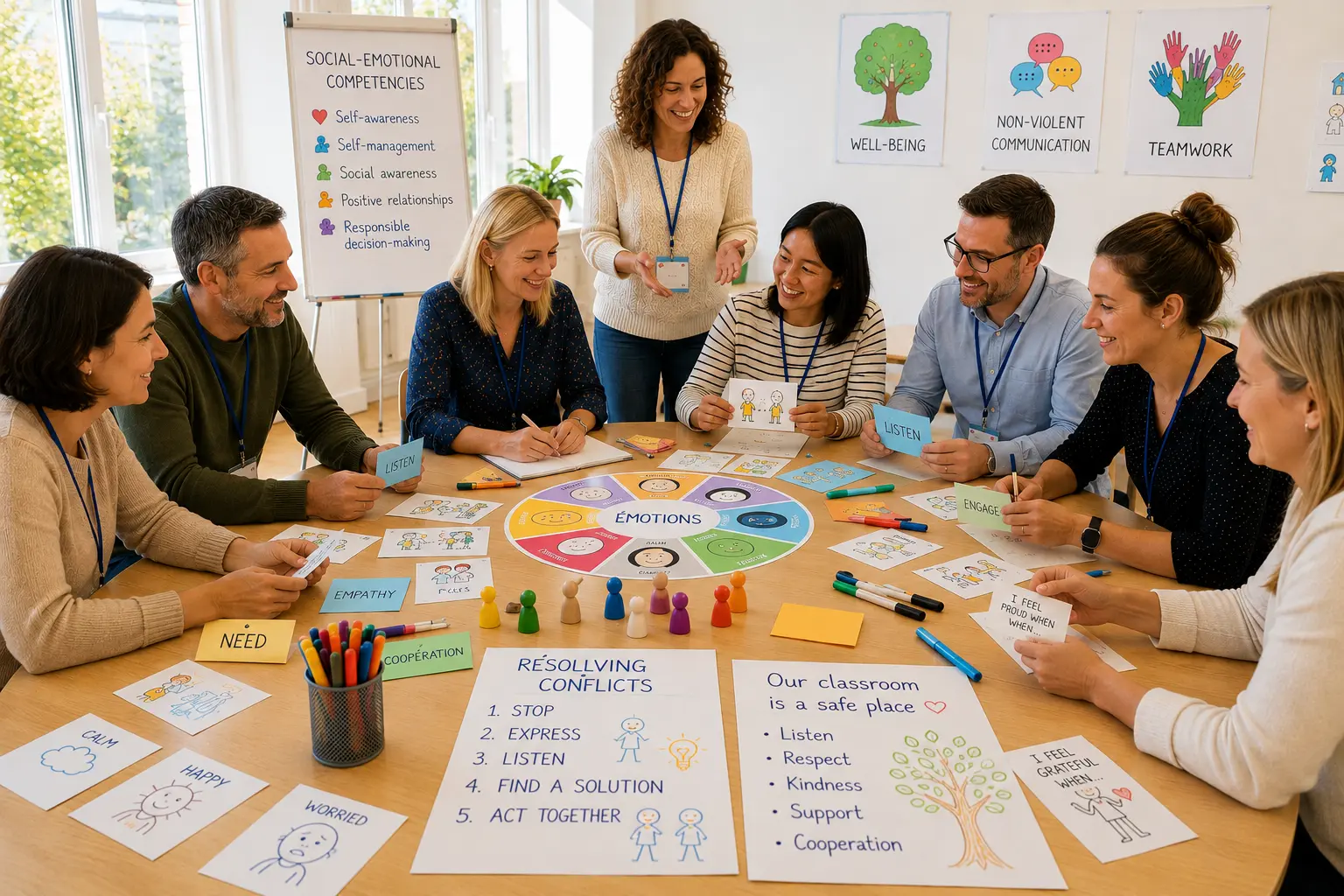
In this Erasmus+ course in Bordeaux, you will reflect together with teachers from across Europe and leave with concrete activities to run with your own students: exercises that build empathy, emotional regulation and non-violent communication, plus a prevention plan adapted to your school. Every learning objective is differentiated for the maturity and knowledge of your students, whether you teach in primary, lower secondary or upper secondary education.
Why a social emotional learning course?
- Bullying has mechanisms: understanding how it starts, escalates and silences bystanders is the first step to stopping it.
- Psychosocial competencies protect: empathy, cooperation and emotional regulation are the strongest everyday levers of prevention.
- Climate drives learning: students who feel safe and connected learn better, participate more and support each other.
- Prevention beats reaction: a structured, whole-class approach reaches situations that individual sanctions never see.
- Teachers are the key: with the right activities, every lesson can quietly build the skills that make bullying unnecessary.
The course draws on the international evidence base for social and emotional learning, notably the framework developed by CASEL, the reference research organisation in the field.
Three dimensions your students will grow in
The activities you will design during the week help students progress along three complementary dimensions, with objectives differentiated by age and maturity:
- Knowing themselves: living and growing with their body, recognising and naming their emotions, building self-esteem.
- Meeting others: building relationships and thriving in them, cooperating, communicating without violence, developing empathy.
- Finding their place in society: acting freely and responsibly, standing up as an active bystander, contributing to a respectful school community.
What you will learn in this social emotional learning course
What you will be able to do after this course
Explore the course in detail
- Understand the mechanisms of school bullying and their impact on school climate.
- Identify the role of psychosocial competencies in bullying prevention.
- Implement teaching strategies that foster empathy, cooperation and emotional regulation.
- Design concrete prevention actions adapted to your school context, with objectives differentiated for primary, lower secondary and upper secondary students.
The week alternates reflection and production: you think each theme through together with colleagues from other countries, then immediately turn it into activities for your own students.
- Structured input on psychosocial competencies.
- Analysis of real situations and case studies.
- Practical workshops: role plays and simulations.
- Progressive design of a prevention plan adapted to your context and to your students' level, from primary to upper secondary.
- Continuous formative feedback throughout the week.
This course is designed for teachers of any subject who want to act on classroom climate, whether they face bullying situations today or want to prevent them tomorrow.
It also welcomes trainers, educators, headteachers, school leaders and administrative staff involved in wellbeing policies. Because objectives are differentiated by level, primary, lower secondary and upper secondary teachers all design activities for their own students. A minimum A2 level is required, the course can be delivered in the language of your choice, and groups of 10 to 16 mix roles and countries.
| Day | Theme |
|---|---|
| Monday | Understanding school bullying. Morning: definitions, typologies and mechanisms, psychological and social impacts. Afternoon: analysis of real cases and identification of risk factors. |
| Tuesday | Emotional skills. Morning: developing the recognition and regulation of emotions. Afternoon: workshop, designing activities that build empathy. |
| Wednesday | Communication and cooperation. Morning: non-violent communication and conflict management. Afternoon: role plays and classroom simulations. |
| Thursday | Prevention and school climate. Morning: collective prevention strategies and student involvement. Afternoon: designing a prevention scheme adapted to your school. |
| Friday | Implementation and transfer. Morning: structuring an institutional action plan. Afternoon: project presentations, follow-up plan and Europass certification. |
As a host organisation for Erasmus+ teacher training in Bordeaux, we support you at every step of your mobility.
Before your mobility
- Needs-analysis questionnaire and review of your school context
- Identification of the climate challenges in your own school
- Preparatory resources on psychosocial competencies and bullying prevention
- Learning Agreement, Quality Commitment and Erasmus+ KA1 application support
After your mobility
- Final course evaluation and support for your Erasmus+ reporting
- Certificate of attendance and Europass Mobility document
- Access to shared teaching resources
- An action-plan template for running a prevention programme in your school
Working on emotions and relationships asks a lot of participants, and the setting matters: Bordeaux offers the calm, welcoming environment this course needs.
- A safe distance: stepping away from your own school makes it easier to look honestly at its climate and plan change.
- European perspective: teachers from across Europe compare how their systems prevent bullying, during your Erasmus+ mobility.
- Inspiring setting: a UNESCO-listed city whose quality of life supports a week of reflection and cooperation.
- Accessibility: high-speed rail and an international airport make Bordeaux easy to reach.
Target audience
Whatever your subject, this social emotional learning course is aimed at teachers, trainers, educators, counsellors (educational and career), school psychologists, headteachers, school leaders and administrative staff, in primary, lower secondary, upper secondary, vocational and adult education, with a minimum group of 10 and a maximum of 16 participants.
Erasmus+ funding: how it works
Teachers, trainers, headteachers, school leaders and other education staff can apply for an Erasmus+ KA1 grant, so your institution may cover travel, board and lodging, cultural activities and the fees of this social emotional learning course through the grant. This course is part of our Erasmus teacher training courses in Bordeaux.
The course is priced to fit within the Erasmus+ grant, with a range of options so you can balance comfort and quality while staying within it.
Erasmus+ quality standards
As a host organisation based in Bordeaux (OID E10260484), we comply with the Erasmus+ quality standards for course providers: transparent objectives and learning outcomes, needs analysis before the course, active and participative methodology, and full documentation for your national agency.
What is included in the course
Official Erasmus+ validation
To ensure the recognition of your social emotional learning course, we provide all required European certification and Erasmus+ compliance documentation:
- ✓ Europass Mobility: Official recognition of your professional development and teaching skills.
- ✓ Quality Commitment: Full compliance with Erasmus+ quality standards.
- ✓ Final Certification: Official certificate of attendance with training hours.
Frequently asked questions
Yes, this course is fully eligible for Erasmus+ KA1 mobility funding, which can cover travel, accommodation and the course fees depending on your project.
Yes. Learning objectives are differentiated to match the maturity and knowledge of your students, whether you teach in primary, lower secondary or upper secondary education, and the activities you design during the week are built for your own level.
No. The course provides structured, accessible input on psychosocial competencies and translates it directly into classroom activities. What matters is your willingness to work on classroom climate with your students.
One-week sessions run monthly, extendable up to four weeks, with 20 hours per week from Monday to Friday. You receive a certificate of attendance and a Europass Mobility document, with full Erasmus+ compliance documentation.
You may also be interested in
Explore the other courses of our inclusive education category:
Erasmus+ teacher mobility in Bordeaux
Build a class where bullying cannot take root
Join this social emotional learning course with Erasmus+, reflect together with European colleagues, and go home with concrete activities that help your students know themselves, connect with others and find their place.
Start my project