Arts education and citizenship course: heritage, creativity and European identity
Use Europe's artistic and cultural heritage as a classroom: an Erasmus+ week in Bordeaux to design creative projects that build intercultural dialogue and active European citizenship, transferable to your own town.
Plan your Erasmus mobilityInnovative pedagogy course for teachers · Part of our Erasmus+ teacher training courses in Bordeaux
A mural can open a debate. A heritage site can teach history, language and belonging at once. A collaborative artwork can make twenty-five students experience what European unity in diversity actually feels like. Art is not decoration added to the curriculum: it is one of the most powerful levers of active citizenship a teacher can use.
In this Erasmus+ arts education and citizenship course in Bordeaux, you will explore how European artistic and cultural heritage becomes a transversal teaching support, practise on real sites and real works, and design a creative project with a European dimension that you can implement in your own school, with your own local heritage.
Why an arts education and citizenship course?
- Citizenship is learned by doing: analysing, debating and creating around works of art trains students to consider other points of view and manage disagreement with respect.
- Heritage tells Europe's story: the artistic heritage around every school carries the shared history and diversity that make European identity concrete for students.
- Art includes: creative activities give a voice and a place to students that traditional formats leave aside, making art a genuine lever of engagement and inclusion.
- Dialogue needs a medium: intercultural exchange becomes natural when students create together around works, places and stories rather than debating in the abstract.
- It works in every subject: art and heritage support language, history, geography, science and citizenship education alike, without requiring any artistic specialisation.
The course draws on Europe's shared cultural heritage as a teaching resource, notably through Europeana, the European Union platform giving classrooms access to millions of digitised artworks, documents and heritage objects.
Bordeaux as a laboratory, not a destination
You will not visit Bordeaux: you will use it. The city offers an exceptional diversity of learning environments within walking distance, and every exercise you run there is designed to be reproduced at home:
- The training ground: UNESCO-listed heritage, museums, contemporary creation spaces, public art, architecture and riverbanks become the sites where you practise the method.
- The method: observing, questioning and creating from a place or a work, then structuring it into a rigorous learning sequence linked to your curriculum.
- The transfer: everything is rebuilt for your own context, because every town in Europe, whatever its size, has heritage and creation worth teaching with.
What you will learn in this arts education and citizenship course
What you will be able to do after this course
Explore the course in detail
- Understand the role of arts and cultural education in the construction of active European citizenship.
- Explore European artistic heritage as a transversal teaching support.
- Design artistic projects that foster intercultural dialogue.
- Integrate art and culture as levers of engagement and inclusion in the classroom.
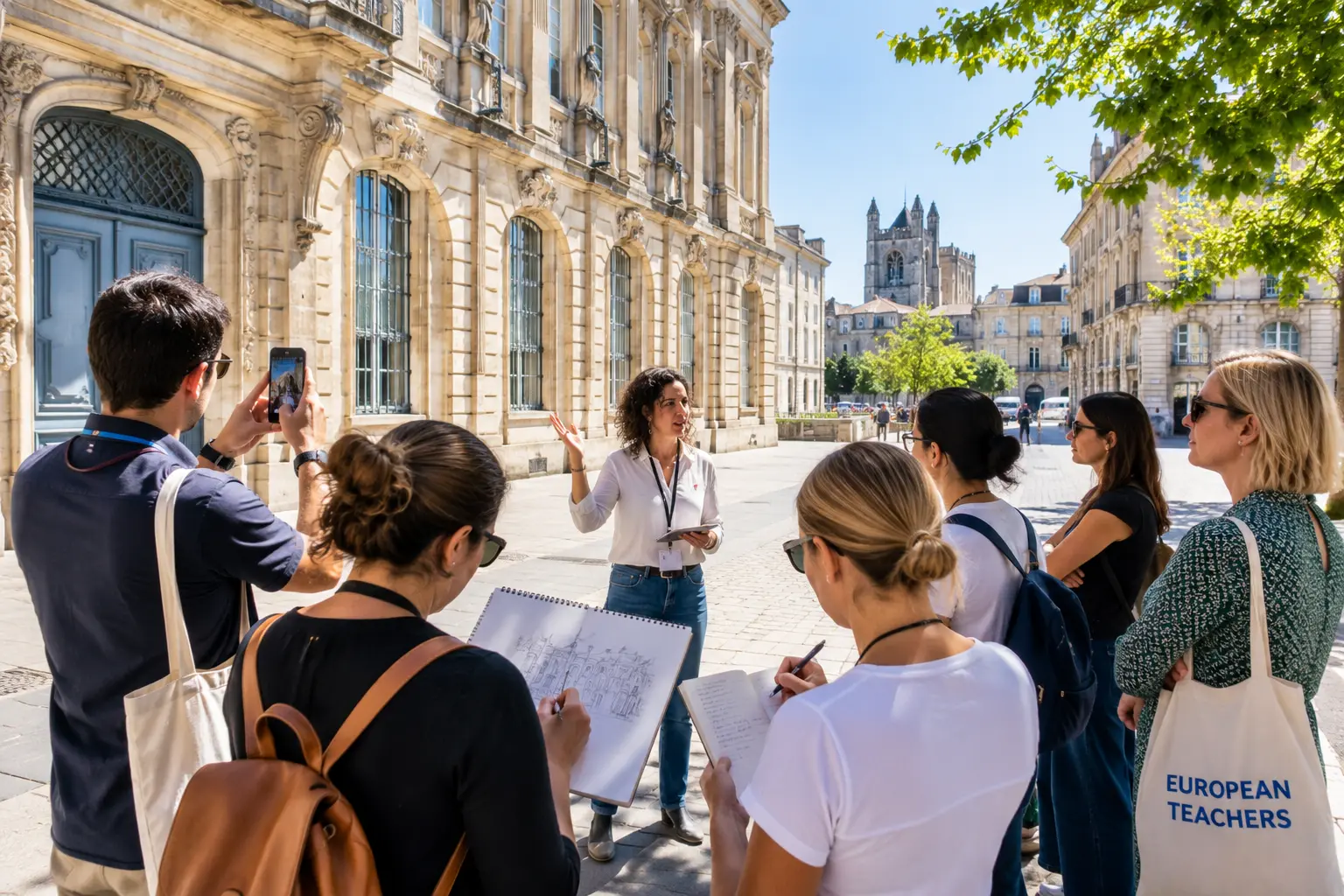
The week alternates fieldwork and design: you observe and analyse real sites and works with colleagues from other countries, then immediately turn them into learning sequences for your own students.
- Collaborative and creative workshops.
- Comparative analyses of European practices.
- Cultural outings and field observations.
- Progressive design of an artistic project with a citizenship dimension.
- Continuous formative feedback throughout the week.
This course is designed for teachers of any subject who want to use art, culture and heritage to build citizenship, dialogue and inclusion, whether or not they have any artistic background.
It also welcomes trainers, educators, headteachers, school leaders and administrative staff developing cultural or European projects for their institution. A minimum A2 level is required, the course can be delivered in the language of your choice, and groups of 10 to 16 mix roles and countries.
| Day | Theme |
|---|---|
| Monday | Art and European citizenship. Morning: foundations of arts and cultural education in Europe, the link between art, heritage and active citizenship. Afternoon: comparative analysis of artistic practices from different European countries. |
| Tuesday | Heritage and territory. Morning: using local heritage as a teaching support. Afternoon: cultural outing and pedagogical analysis of an emblematic heritage site. |
| Wednesday | Intercultural dialogue. Morning: art as a tool for dialogue and inclusion. Afternoon: collaborative creative workshop symbolising unity in European diversity. |
| Thursday | Project design. Morning: structuring an artistic project with a European dimension. Afternoon: collaborative design of projects transposable to the classroom. |
| Friday | Implementation and transfer. Morning: finalisation of the pedagogical project. Afternoon: project presentations, action plan and Europass certification. |
As a host organisation for Erasmus+ teacher training in Bordeaux, we support you at every step of your mobility.
Before your mobility
- Needs-analysis questionnaire and review of your teaching context
- Identification of an artistic or cultural project already run in your school
- Preparatory resources on arts education and European citizenship
- Learning Agreement, Quality Commitment and Erasmus+ KA1 application support
After your mobility
- Final course evaluation and support for your Erasmus+ reporting
- Certificate of attendance and Europass Mobility document
- Access to shared teaching resources
- A template of a European artistic project transferable to your school
For a course that teaches with heritage and creation, the city is not a backdrop: it is the course material, chosen because it concentrates so many usable sites in one walkable centre.
- A living textbook: UNESCO-listed heritage, museums, contemporary creation venues, public art and riverbanks, all within walking distance of the training room.
- European perspective: teachers from across Europe compare how their systems teach with art and heritage, during your Erasmus+ mobility.
- Transferable by design: every exercise run on a Bordeaux site is rebuilt for your own town, whatever its size.
- Accessibility: high-speed rail and an international airport make Bordeaux easy to reach.
Target audience
Whatever your subject, this arts education and citizenship course is aimed at teachers, trainers, educators, counsellors (educational and career), school psychologists, headteachers, school leaders and administrative staff, in primary, lower secondary, upper secondary, vocational and adult education, with a minimum group of 10 and a maximum of 16 participants.
Erasmus+ funding: how it works
Teachers, trainers, headteachers, school leaders and other education staff can apply for an Erasmus+ KA1 grant, so your institution may cover travel, board and lodging, cultural activities and the fees of this arts education and citizenship course through the grant. This course is part of our Erasmus teacher training courses in Bordeaux.
The course is priced to fit within the Erasmus+ grant, with a range of options so you can balance comfort and quality while staying within it.
Erasmus+ quality standards
As a host organisation based in Bordeaux (OID E10260484), we comply with the Erasmus+ quality standards for course providers: transparent objectives and learning outcomes, needs analysis before the course, active and participative methodology, and full documentation for your national agency.
What is included in the course
Official Erasmus+ validation
To ensure the recognition of your arts education and citizenship course, we provide all required European certification and Erasmus+ compliance documentation:
- ✓ Europass Mobility: Official recognition of your professional development and teaching skills.
- ✓ Quality Commitment: Full compliance with Erasmus+ quality standards.
- ✓ Final Certification: Official certificate of attendance with training hours.
Frequently asked questions
Yes, this course is fully eligible for Erasmus+ KA1 mobility funding, which can cover travel, accommodation and the course fees depending on your project.
Not at all. This course is transversal: art and heritage are used as supports for citizenship, dialogue and inclusion in any subject, from languages and history to science and mathematics. No artistic skill is required, only curiosity and the wish to make your students create and think together.
No. Bordeaux is the laboratory, not the subject. Its heritage sites, museums and public art are the training ground where you practise a method, and everything you design during the week is built to be transferred to your own town and your own local heritage, whatever its size.
One-week sessions run monthly, extendable up to four weeks, with 20 hours per week from Monday to Friday. You receive a certificate of attendance and a Europass Mobility document, with full Erasmus+ compliance documentation.
You may also be interested in
Explore the other courses of our innovative pedagogy category:
- Outdoor learning and active pedagogy
- Active and creative teaching methods
- Neuroscience and educational practice
Erasmus+ teacher mobility in Bordeaux
Teach citizenship with Europe's heritage
Join this arts education and citizenship course with Erasmus+, create alongside colleagues from across Europe, and go home with a heritage-based project that makes European citizenship something your students build, not just study.
Start my project